


Ad
You know what needs to be done. But your team is maxed out.
The strategy is set. The roadmap is there. But you don't have the people to get it done. And hiring takes 6 months.
The solution: Interim management. An experienced executive, brought in for the mission. As COO, CFO, or plant manager. Someone who's solved this before.
That's what Atreus does. For OEMs, suppliers, and tech companies in automotive.
Martin Hunglinger from Atreus will tell you if interim management is the right move. No strings attached.
Welcome to Issue #108 of The German Autopreneur.
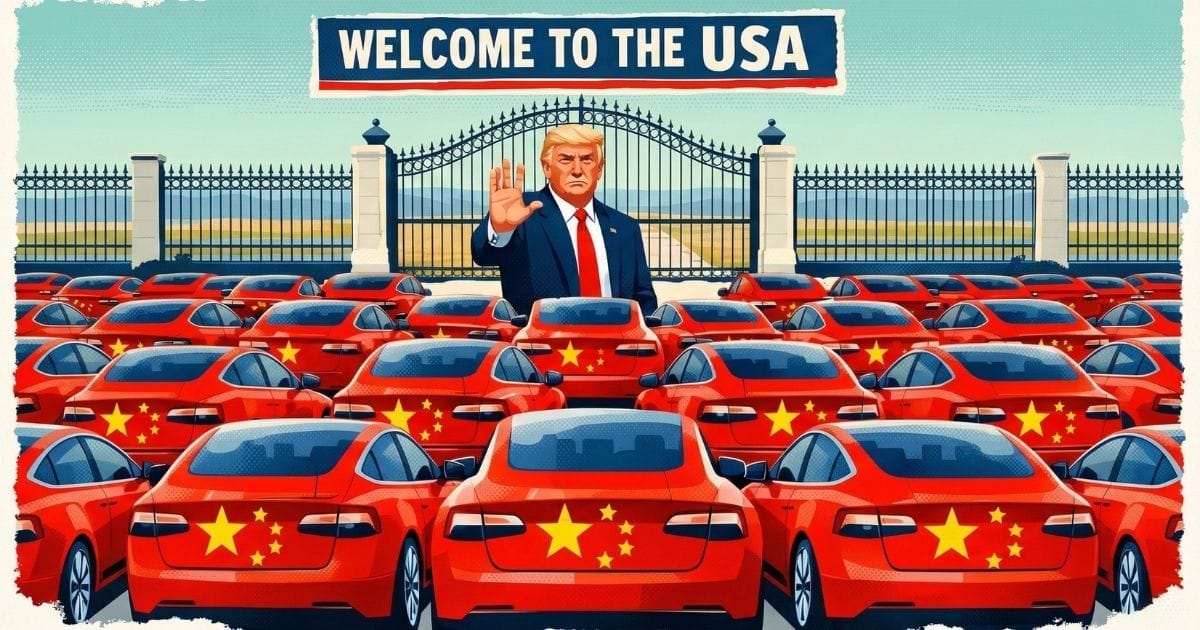
January 2026. Detroit. Donald Trump talks about Chinese automakers. And says: "Let China come in."
He means they should build factories in the US. Hire Americans.
For context:
The US has 100%+ tariffs on Chinese EVs
A ban on Chinese software and hardware in cars
And a president who made the trade war with China his trademark
The idea comes from Ford CEO Jim Farley. And a playbook the auto industry knows all too well.
Today we'll look at why the US might open its auto market to China right now. And what it means for Europe.
Jim Farley Is Scared
January 2026. Ford CEO Jim Farley meets with senior Trump administration officials.
His pitch: Let Chinese manufacturers produce in the US. In joint ventures with American companies. The US firm holds the majority. They share profits and technology.
Why does he want this?
In December 2025, Ford buried its EV strategy:
Multiple electric models canceled
$19.5 billion written off
The EV division alone has lost over $16 billion since 2022.
On China, Farley says: "They have enough capacity in China with existing factories to serve the entire North America market. Put us all out of business."
And: "If we lose this, we do not have a future at Ford."
He means the global technology race with China. Not just EVs. Software, batteries, connected vehicles too.
BYD overtook Ford in global sales. Farley privately drives a Xiaomi SU7 he imported from China. He calls Xiaomi "the Apple of China." The man knows what's coming.
Farley's logic: Better to bring in Chinese technology through joint ventures now. Than get overrun in 5 years.
But it's not that simple.
The 3 Walls
When Chinese automakers try to enter the US, they face 3 walls.
Wall 1: Tariffs.
100%+ on Chinese imports. Their cars can't compete.
Wall 2: The Tech Ban.
The US banned Chinese software and hardware in connected vehicles. Software starting 2027, hardware starting 2030. The rule applies not only to imports but also to cars built in the US.
The former US Commerce Secretary put it this way: "It's really important because we don't want two million Chinese cars on the road and then realize we have a threat." For the US, Chinese cars are a national security issue.
Wall 3: Trust.
And even if walls 1 and 2 fall, no American knows BYD. No dealer sells their cars. No mechanic can fix them. Chinese manufacturers would need years to establish themselves. Just like we're seeing in Europe right now.
The US market is pretty locked down for Chinese manufacturers.
And then Trump suddenly says: "If they want to come in and build the plant and hire you and hire your friends and your neighbors, that's great. I love that. Let China come in."
So what's going on?
The Playbook Reverses
For Trump, the math is simple. Factories in the US mean American jobs. For Farley, it goes deeper. Technology transfer.
There's a model the auto industry knows well.
In 1984, VW became one of the first Western automakers to form a joint venture in China. With state-owned SAIC. The deal. Market access for technology transfer.
This wasn't an isolated case. For almost 40 years, China forced Western manufacturers into joint ventures. The strategy. Learn from partners. Build your own tech.
It worked. Chinese manufacturers caught up in the software era. Then overtook them.
Farley now faces the same problem. Ford has a massive gap in software and batteries. They tried catching up alone. Ford spent 4 years building its own software platform. Following Tesla's model. In 2025, the project was scrapped. Just like the EV strategy now.
So he's reversing the logic. Bring in Chinese technology through joint ventures. With American majority ownership. Under American control. Learn from Chinese technology.
Same playbook. Just in the other direction.
But there's a catch.
The Commerce Department's software ban applies not only to imports. It also covers cars built in the US. If a joint venture uses Chinese software or hardware in connected vehicles, those vehicles won't be sellable starting 2027. No matter who holds the majority stake.
A joint venture doesn't solve the core problem. Unless the rules change. And there's a sign the rules might change. In January 2026, the Trump administration fired the Commerce Department official who led the software ban.
And the US isn't alone in making moves.
Canada Opened the Door
On March 1, 2026, a deal between Canada and China took effect. Canada cut tariffs on Chinese EVs from 100% to 6.1%. Up to 49,000 vehicles per year can be imported.
In return, Canada expects Chinese manufacturers to form joint ventures with Canadian companies within 3 years. Build factories. Create jobs. This isn't legally binding. But the message is clear: those who want long-term market access should invest locally.
Trump isn't thrilled. He warned Canada against becoming a "drop off port" for Chinese cars.
Something similar happened at the southern border.
BYD wanted to build a large plant in Mexico. The plan failed. China itself delayed approval. The fear. Technology could flow to the US through Mexico.
And Trump pressured Mexico. Anyone cooperating with China risks US market access. Mexico took the opposite approach. In December 2025, the government raised tariffs on Chinese cars from 20% to 50%.
Still, roughly one in five cars sold in Mexico already comes from China.
And something is happening in the US too.
At CES 2026, Geely announced plans for Zeekr and Lynk & Co to enter the US market within 24 to 36 months. Geely also owns Volvo. Volvo already has a factory in South Carolina. It's currently running at only 13% capacity. The infrastructure for a US market entry already exists.
My Take
China benefited from Western technology for 40 years. Through forced joint ventures. And it worked.
Now the US might flip the model.
Late March, Trump travels to Beijing to meet Xi Jinping. Access to the US auto market could be part of the negotiations. And Farley already put the model on the table.
We know Trump's pattern:
First, shut out the other side. High tariffs. A software ban. Pressure
Take away something they want: access to one of the world's largest markets
Then negotiate. Offer exactly that back. But not for free
What does this mean for European automakers?
If such a joint venture model actually comes to the US, it would naturally favor US companies.
Ford would get access to Chinese technology. European manufacturers probably wouldn't. They're not US companies.
But that's not the only problem.
In the US market, they'd suddenly compete against the same Chinese manufacturers they're already fighting in China and Europe.
And there's one more irony.
While the US considers a joint venture model, China is phasing it out. Toyota is building a fully owned factory for Lexus in Shanghai. Without a joint venture partner. The second plant after Tesla to produce in China without a Chinese partner.
China no longer forces joint ventures. It doesn't need them anymore.
This brings us to Europe. Compared to the US, our walls are much lower.
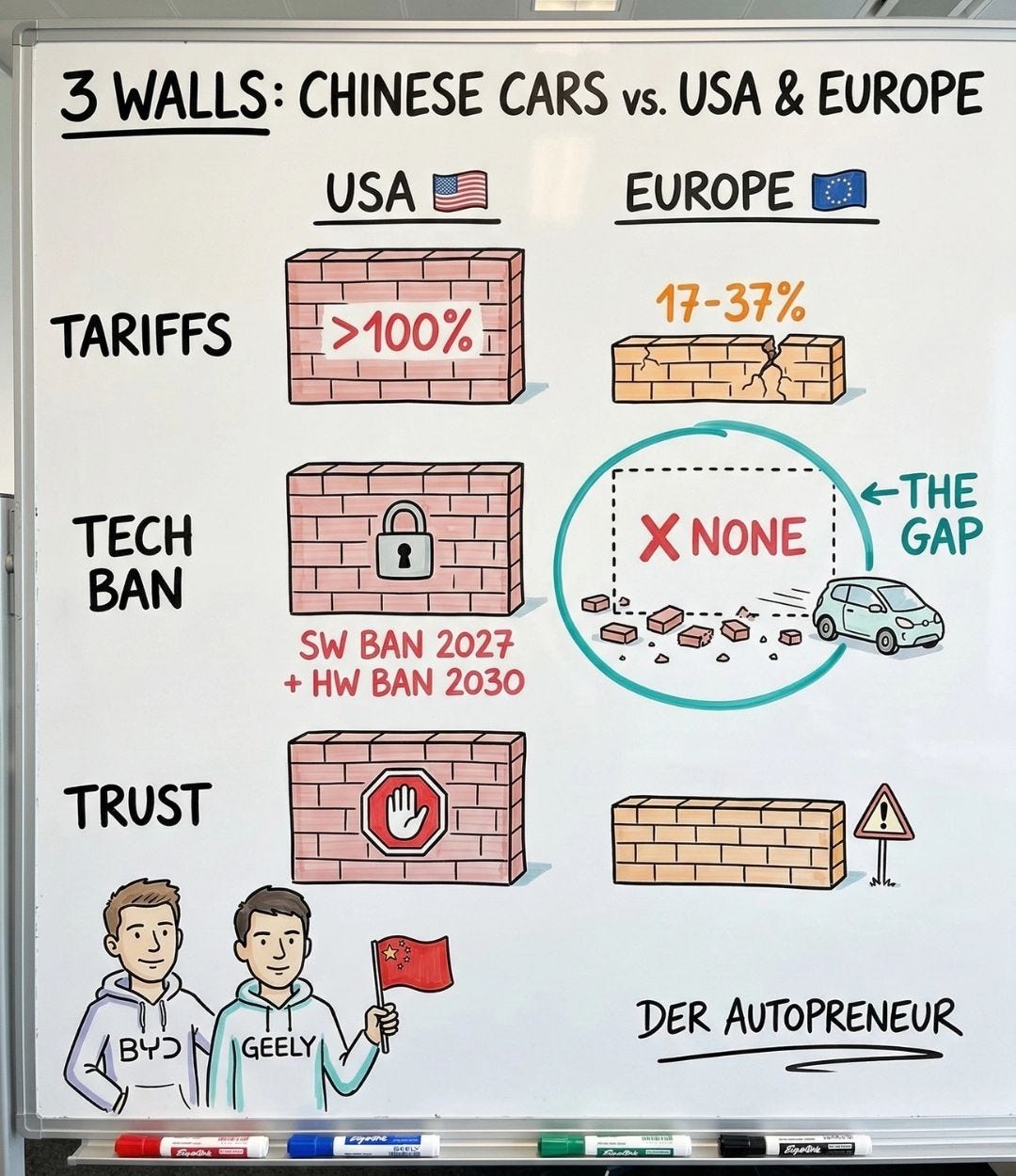
Europe has tariffs of up to 45% on Chinese EVs. But they can be circumvented. Either through local production. Or through minimum prices and quotas, which the EU is negotiating with individual manufacturers. There's no tech ban. And Chinese manufacturers are already active in Europe building trust.
Does Europe need a joint venture requirement too?
I think yes. Urgently.
Tariffs alone don't solve the problem. When Chinese manufacturers build factories in Europe, they create jobs. But only in production. Exactly the kind of jobs automation will replace anyway.
The real value stays in China. The software, battery technology, platforms. The intellectual property. That's what needs to come to Europe. Not just assembly.
The problem. Enforcing something like this is a matter of negotiation. And in this negotiation, we're in a weaker position than the US.
The US can negotiate from strength. China has strategic dependencies on the US in many areas.
Europe is different. Sure, China wants access to the European market. That's our bargaining chip. But we want access to the Chinese market just as much. VW, Mercedes, and BMW do a huge share of their business there. And not just cars. Also rare earths, chips, raw materials. Europe has strategic dependencies on China in many areas.
Bottom line. Europe probably needs China more than China needs Europe. Not a great position when you need something from the other side.
But Europe won't close the technological gap without controlled cooperation. Late March, Trump negotiates in Beijing. Canada already has its deal. It's time for a European initiative.
🔗 dp | bl | re | ft | cnn | li
That's all for today.
Until next week,
Philipp
PS: If you find value here, share it with someone who should read it too.
Want to reach European automotive decision makers?
I help global B2B companies connect with 80,000+ automotive decision makers in Germany.