


A word from me:
Your shortcut into European automotive
Selling to BMW, Bosch, or Continental from outside Germany? Good luck.
German automotive is a closed club. Built on trust, relationships, and decades of doing business face to face. Cold outreach doesn't work. Trade fairs cost €20,000 for maybe 3 real conversations. And nobody takes meetings with companies they've never heard of.
I spent 10 years inside Mercedes-Benz. Today, 80,000 European automotive decision-makers follow me. From team leads to board level. They trust me. Because I speak their language. Literally.
One partner generated 250 webinar signups. Another got 60 qualified leads at OEMs.
I'm your bridge into the German automotive ecosystem.
👉 All partnership details here
Welcome to Issue #104 of The German Autopreneur.
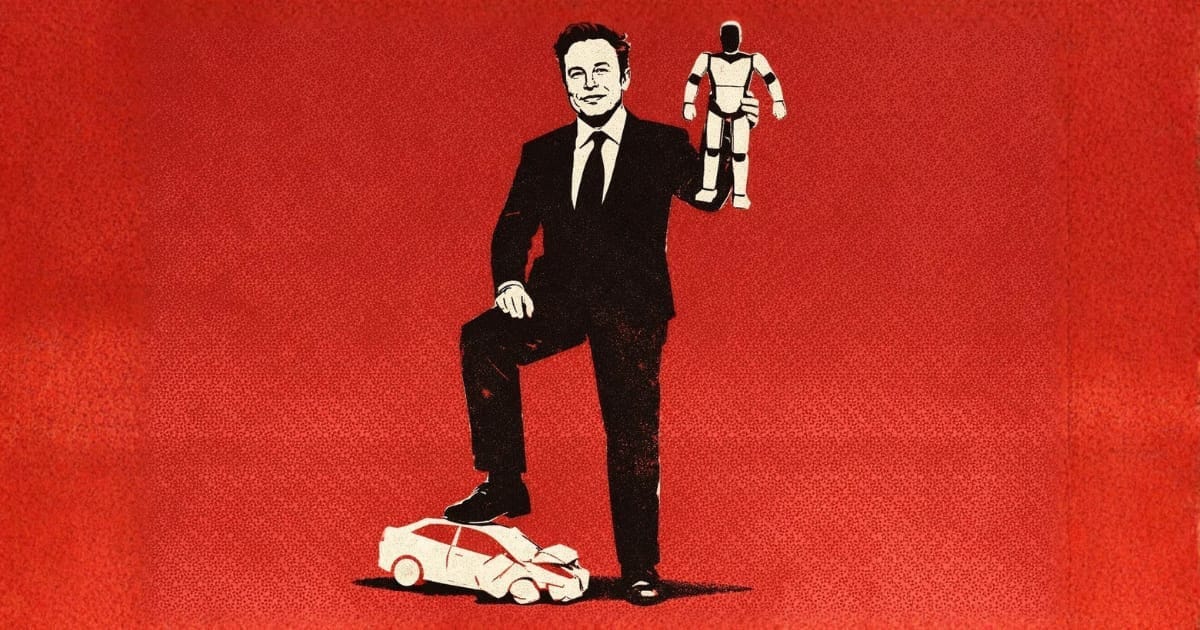
Imagine Porsche killing the 911. That's exactly what Tesla did.
The Model S is being discontinued. The car that changed the industry in 2012. The car that started the Tesla legend.
But this is just the beginning.
Tesla isn't just losing a model. It's losing its entire car business. And Elon Musk? He has a plan.
Today we'll look at what's really happening. Is Tesla reinventing itself? Or is this the beginning of the end?
The Underdog Story
To understand what's happening, we need to look back briefly.
In 2012, Tesla launches the Model S.
The industry laughs. An electric car from a startup? That'll never work.
Remember former VW CEO Matthias Müller? In 2017, he dismissed Tesla as a niche player. No serious competition for VW.
Three years later, Tesla was worth more than VW, BMW, and Mercedes combined.
The Model S made EVs cool. No longer a niche eco-statement. But a desirable product for the tech-savvy elite.
And something else: The idea that a car could get better overnight. Through software updates. Like a smartphone. Tesla invented the software-defined vehicle.
They became the symbol for everything traditional automakers couldn't achieve. The outsider who pulled off the impossible.
Elon became the richest person on Earth. And in 2020, Tesla became the most valuable automaker. The Model S turned the automotive industry upside down. And kicked off a new era.
This exact car is now being discontinued.
What Happened?
The 2025 numbers tell the story:
Revenue: $94.8 billion (-3%)
Profit: $3.8 billion (-46%)
Deliveries: 1.6 million vehicles (-9%)
Q4 is even worse: Profits collapsed 61% to $840 million. For comparison: In 2022, Tesla made around $3.7 billion in a single quarter.
It's the first time in company history that revenue has declined.
The biggest blow: BYD overtakes Tesla as the world's largest EV manufacturer. In 2011, Elon Musk laughed at BYD. Years later he admitted their cars are "very competitive."
Model S and Model X? Together with Cybertruck, they now make up just 3% of sales. 50,000 units compared to 1.6 million Model 3 and Y.
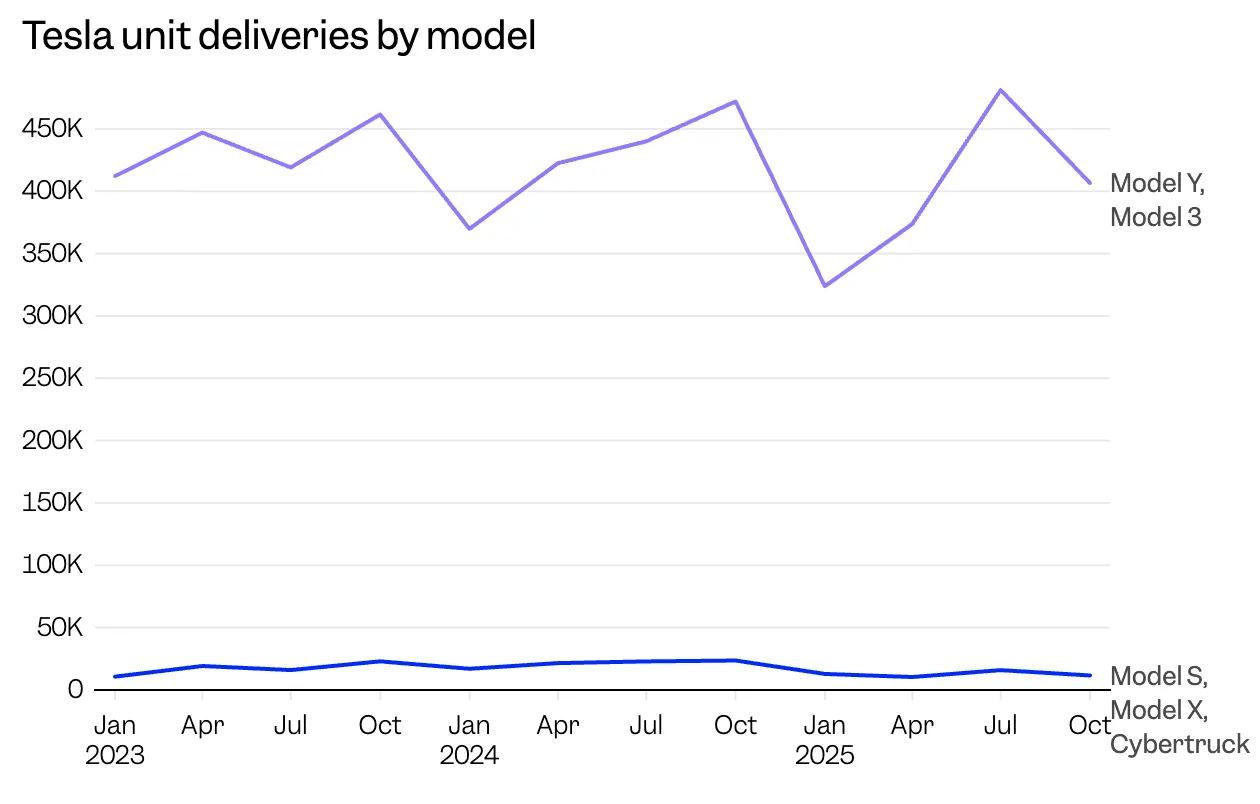
Elon himself admitted years ago: Model S and X are now only built for "sentimental reasons."
And that's over.
Why Are the Numbers So Bad?
1. The Product: The model lineup is outdated. Since Model Y in 2020, no new mass-market model has followed. The long-promised $25,000 car? Cancelled in favor of the robotaxi. The only new model was the Cybertruck. And that flopped.
2. The Competition: The first-mover advantage is gone. In 2012, Tesla was alone. Today, every automaker builds EVs. If you want an EV today, you've got options. And the biggest competition comes from China. They're cheaper and have much newer models.
3. Musk Himself: Whether you agree with his politics or not: His involvement has damaged the brand. In Europe alone, Tesla sold around 28% less in 2025 even though the market grew.
4. The Politics: The Trump administration is doing everything to suppress EV adoption. This particularly hurts Tesla. EV purchase subsidies were eliminated. Plus, revenue from selling CO₂ credits is collapsing. Tesla made billions from that for years.
Tesla's Response?
Away from cars. Toward what Tesla calls "Physical AI."
This isn't the AI that writes emails or generates images. This is AI that operates in the real world. That sees, moves, interacts with things. Robotaxis. Humanoid robots.
And Tesla is serious. Three projects are the focus:
1. Optimus: Tesla is converting its plant in Fremont, California. They used to build Model S and X there. Now they're switching production lines to the humanoid robot Optimus. Long-term goal: 1 million robots per year.
2. Robotaxis: Tesla's robotaxi service already runs in Austin, still with safety drivers. In San Francisco, Tesla offers a ride service with drivers. 7 more US cities are planned for the first half of the year. Plus, the Cybercab should enter production in April. A car designed to work without a steering wheel or pedals.
3. xAI: Tesla is investing $2 billion in Musk's AI startup xAI. The reasoning? Synergies in autonomous driving.
To finance all this, Tesla is investing over $20 billion in 2026. More than double what it spent in 2025.
Analysts sum it up: "Forget the Tesla you knew. The Tesla of yesterday is gone." They call it a "point of no return." There's no going back.
What's Really Happening
The official story: Tesla is transforming from automaker to AI company.
Analysts have another name for it: "The Great Decoupling." Tech analyst Scott Galloway calls it a distraction from the shrinking car business.
Let's take a closer look.
Robotaxi:
Elon has promised Full Self Driving for years. With the robotaxi, he doubled down
Waymo does 400,000 rides per week. In 6 cities. With 2,500 vehicles
Tesla? The last known numbers put it at 34 vehicles. A fan documented 54 rides in Austin. None were truly driverless. Every ride had an escort vehicle. In California, Tesla has no permit for driverless robotaxis
And the Cybercab? US regulations allow a maximum of 2,500 such vehicles per year. Tesla wants to build millions
Optimus:
In 2024, Elon claimed the robot could make Tesla a $25 trillion company
Today he says Optimus isn't deployed in Tesla's factories yet. It's an R&D project
And unlike EVs, Tesla isn't the first mover here. Boston Dynamics, Unitree, Xpeng, and many others are in the race
Just like with EVs, whoever produces cheapest wins in the end. So China is well positioned
xAI:
Elon's AI startup burns around $1 billion per month. With only $500 million annual revenue
For comparison: OpenAI expects $13 billion revenue for 2025
That's the reality check.
Still: Tesla is worth more than the 25 largest automakers combined.
How does this make sense?
Tesla has always been valued like a tech company. Not like an automaker. You see this in the price-to-earnings ratio:
VW is around 5
Ford around 8
Apple and Amazon 30 to 40
Tesla? 250+
This worked as long as the car business carried the growth story. It doesn't anymore. So it needs new narratives.
That's why more and more analysts call Tesla a "meme stock." The valuation has decoupled from reality. The price isn't driven by revenue and profit anymore. But by hype, hope, and a loyal fanbase.
And there's something else Tesla shareholders should understand.
Elon doesn't just own Tesla. He controls SpaceX and xAI too. And money flows between these companies.
An example:
Elon buys Twitter for $44 billion
The value crashes to $9 billion
Then xAI buys Twitter and suddenly values it at $33 billion again
The Twitter investors? Saved. Who paid? The xAI investors
And who finances xAI? Among others Tesla and SpaceX. Both invested $2 billion.
This leaves a bad taste. Tesla shareholders already sued Elon in 2024. The accusation: He diverted employees and resources from Tesla to xAI. The lawsuit is ongoing.
Still, SpaceX is now taking over xAI completely. And a merger of Tesla and SpaceX is also on the table.
The pattern: When one of Elon's companies gets in trouble, another bails it out. That's financial engineering. And nobody does it better than Elon.
But there's a problem.
Elon Musk holds around 15% of Tesla. Significantly more of SpaceX and xAI. When he negotiates a merger, he sits on both sides of the table. He negotiates with himself. And because he owns more of SpaceX, he probably won't negotiate in Tesla shareholders' interests.
My Take
To be fair: Not everything's going badly. The energy division grew 27% to $12.8 billion. Battery storage and solar systems.
But the real story is different. It's not that Tesla is abandoning cars. It's that Elon has lost focus.
The car business is shrinking. In robotics and robotaxis, they have no real moat. But the stock valuation says Tesla will dominate these markets. That's anything but certain. And then there's the question of whose interests Elon actually represents.
The paradox: Elon Musk identified the right topics early. EVs. Software. Autonomous driving. AI. Robotics. The problem: At some point, the car business became too boring for him.
And so Tesla gradually lost its lead. In EVs, they're now one of many. In the markets of tomorrow, they're no longer the first mover.
Whether these bets pay off remains to be seen. But there's one indicator: If Tesla actually merges with SpaceX someday, that's a sign. Then we'll know: Things don't look good.
Until then, there's one counterargument. And that's Elon Musk himself.
He's been underestimated too many times. And managed to turn it around in the end.
Matthias Müller had to learn that too.
🔗 Sources
That’s all for today.
Until next week,
Philipp
PS: If you find value here, share it with someone who should read it too.
Want to reach European automotive decision makers?
I help global B2B companies connect with 80,000+ automotive decision makers in Germany.