


Welcome to Issue #106 of The German Autopreneur.
Mercedes released its 2025 annual numbers last week. Profits are down by half. Margins sit at 5%. Three years ago, they were close to 15%.
But the numbers are only part of the story.
In the last 18 months, CEO Ola Källenius has changed course 4 times:
Abandoned the luxury strategy
Brought back the A-Class
Dropped Level 3 autonomous driving
Completely reversed their EV design direction
The problem? Every one of these strategies was his own idea. And he killed every single one himself.
Källenius is correcting Källenius.
Today we'll look at what these numbers really mean. Why Mercedes' largest shareholders are also direct competitors. And why Mercedes is losing something no amount of money can buy back.
The 2025 Numbers
Let's get everyone on the same page.
Financials
Revenue: €132.2B (-9%)
EBIT: €5.82B (-57%)
Passenger Car Division margin: 5.0%
Dividend: €3.50/share (down from €4.30)
Adjusted for one-time items, the result is €8.2B. Still -40%.
Sales by region (total: 1.8M cars, -9.2%)
China: 551,900 (-19%). The overall market grew. Mercedes isn't shrinking because the market is shrinking. Mercedes is losing customers.
USA: 284,650 (-12%)
Europe: 635,000 (-1%). The only stable market.
Rest of World: 98,700 (+17%). Strong, but not enough volume to offset China and the US.
Sales by segment
Top-End (S-Class, G-Class, Maybach, AMG): 268,000 (-5%)
Core (C-Class, E-Class): 1,050,000 (-10%)
Entry (compact): 483,000 (-10%)
The luxury segment held up best. The G-Class had its best sales year ever in 2025. The problem? Top-End alone can't carry the company. It's only 15% of total sales.
Powertrain mix
Combustion/mild hybrid: ~1.43M (~79%)
PHEV: 200,000 (+9%)
BEV: 169,000 (-8.8%). 9% share. At BMW, it's ~18%.
Those are the numbers.
But the real question isn't how bad 2025 was. It's why.
4 Strategy Reversals in 18 Months
#1 The End of the Luxury Strategy
To understand what's happening at Mercedes, we need to go back to the COVID era.
Semiconductors were scarce. Demand exceeded supply. So automakers focused on high-margin models. Customers bought anyway. Margins exploded. Around €20B in operating profit. More than Mercedes had ever earned.
For Mercedes, this felt like validation. They'd been working on a luxury strategy for years. I saw the early stages myself. We called it "Modern Luxury" back then. The idea was to make Mercedes aspirational and exclusive.
Honestly, it felt a bit off even then. Turning a down-to-earth Swabian engineering company into a luxury house like Hermès? That never quite fit.
But the exploding margins seemed to prove the strategy right. Källenius made "Value over Volume" the official mantra. Higher prices. Fewer cars.
That's over now.
The luxury strategy has been quietly abandoned. The new direction is "Profitable Growth." Volume turns out to matter after all.
#2 The Return of the A-Class
I joined Mercedes in 2011. The new A-Class was in development. The strategy: make the brand younger. Internally, we half-jokingly described the typical Mercedes buyer as: male, over 50, probably wearing a hat. It wasn't entirely a joke.
The A-Class was supposed to win over younger customers early. Because everyone knew the core audience was aging out.
And it worked. The A-Class and the compact generation that followed (CLA, GLA, and the rest) made the brand younger. The problem? Margins were bad. These were cars to gain more customers, not money-makers. And entry-level models don't exactly strengthen a luxury image.
So in 2021, Källenius decided to focus on the premium end. The A-Class got killed.
But it’s coming back in 2027.
Källenius now calls the new A-Class "hot as hell."
The reason is simple. If you only build expensive cars, your factories aren't fully utilized. Plants have to close. Jobs disappear. That’s why the entry model is returning.
#3 Level 3 Is Done
In 2022, Mercedes became the first manufacturer in the world to receive approval for Level 3 autonomous driving on German highways. The Drive Pilot.
By 2026, it's history.
The replacement is MB Drive Assist Pro. Level 2 with extended features. The CTO says: "We're still proud of it." But the range of use cases needs to be broader.
Translation: Level 3 was too expensive. And almost nobody bought it.
The problem is that Level 2 and Level 3 feel nearly identical to the driver. But development costs are multiples higher. The industry has largely concluded that Level 3 is a dead end. Most manufacturers want to skip the step entirely.
#4 The EQ Sub-Brand
Mercedes has one of the most recognized brands on Earth. The star is universal. Whether you're in Stuttgart, Shanghai, or São Paulo. The universal status symbol for "I've made it." And a Mercedes is instantly recognizable by its design.
But what happens when Mercedes goes electric? You build cars that no longer look like a Mercedes.
Instead of an electric E-Class or S-Class, Mercedes created the EQ sub-brand. With its own design language. The idea: combustion cars keep the Mercedes look. EVs look like futuristic spacecraft.
The assumption: EV buyers want to stand out. Show the world they're ahead of the curve.
We now know that was a strategic mistake.
Mercedes had its strongest asset and chose not to use it. The brand. The design everyone knows.
With an unknown sub-brand, they went up against hundreds of newcomers. In the EV market, Mercedes was suddenly just as new as everyone else.
The scale of the mistake is clear in one example. The GLC and the EQC were built on the same platform. The GLC was a bestseller. The EQC flopped.
Källenius now admits the futuristic design didn't work. New electric Mercedes cars will look like Mercedes again. The EQ sub-brand is being dissolved.
Mercedes had the strongest brand name in the car market and voluntarily chose not to use it.
Is This a Mercedes Problem or an Industry Problem?
2025 was tough for the entire industry. Trump tariffs, price wars in China, high costs from the EV ramp-up. Everyone felt it.
For context, Mercedes landed at 5% margin in 2025.
But not everyone landed in the same place:
Toyota: ~9%
Kia: 8%
Hyundai: 6.2%
BMW: 5.9% (9M)
Mercedes: 5%
Tesla: 4.6%
VW: 2.3%
Mercedes is in the middle of the pack. But with one key difference. Mercedes sold significantly fewer cars. BMW and Hyundai held steady. Toyota grew.
And in China, sales dropped 19% in a growing market.
So it's both. An industry problem. And a Mercedes problem.
The difference between Mercedes and the winners? Toyota, Kia, and Hyundai didn't change course 4 times in 18 months. Same storm. But whoever holds their course comes out better on the other side.
The Shareholder Problem
Mercedes doesn't just have a strategy problem. Its largest shareholders all want different things.
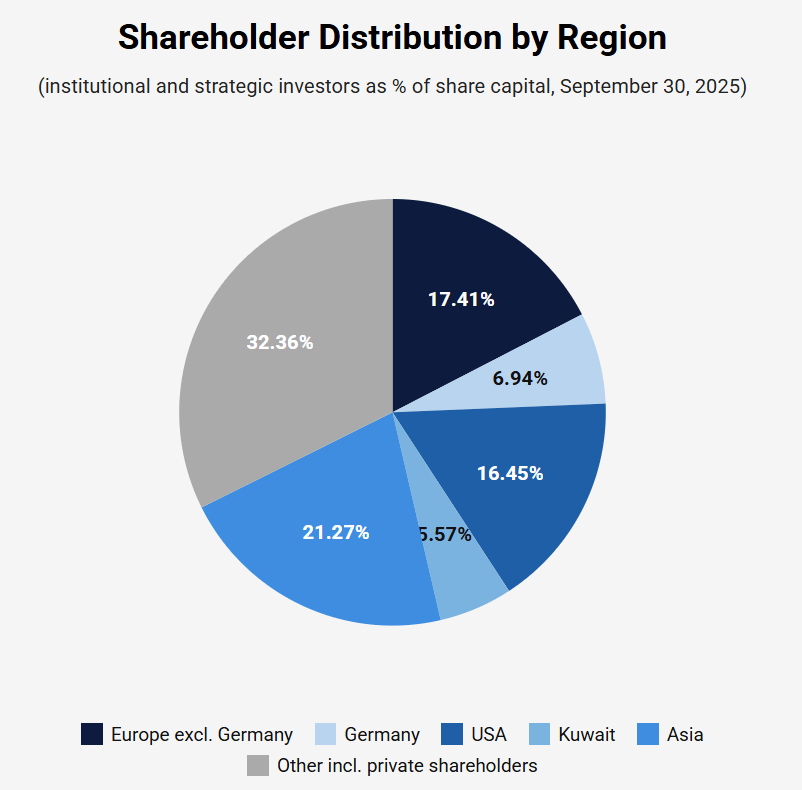
About 20% of Mercedes is owned by Chinese investors. BAIC holds 9.98%. Geely founder Li Shufu holds 9.69%.
BAIC is building the Stelato S9 together with Huawei. A direct competitor to the S-Class. Mercedes' largest individual shareholder is funding a direct rival in the company's most important segment.
Li Shufu founded Geely. Through Zeekr, Polestar, and Lynk & Co, he's building multiple competing premium brands. And through the Horse-Powertrain joint venture with Renault, he's also supplying the engine for the new CLA.
Kuwait's sovereign wealth fund holds 5.57%. Since 1974. The longest-standing shareholder with direct access to the CEO. They want one thing above all: stable returns and no risk.
That explains why Mercedes is paying out billions in dividends despite profits being halved. Long-term investments in the future? Hard to make when major shareholders expect reliable payouts.
So: partner, shareholder, competitor, supplier, sovereign wealth fund. All at the same table. All with different interests.
Imagine being CEO. Trying to find a common direction with these people. You're not running a company anymore. You're doing politics.
My Take
This isn't just about finances. Mercedes is stuck in an identity crisis.
The outlook for 2026: sales at 2025 levels. Margin between 3 and 5%. A few years ago, Källenius defined 8% as the minimum target for "very unfavorable market conditions."
"Profitable Growth" is not a strategy. It's the absence of one. Every company in the world wants to grow profitably. It's the lowest common denominator. The thing everyone can agree on when no one can agree on anything else.
But here's what it doesn't answer:
What does Mercedes stand for? What makes a Mercedes a Mercedes?
A software company would put MB.OS at the center. A luxury brand would lean into scarcity. A volume manufacturer would bring back the A-Class. Mercedes is doing all three at once.
On top of that: 40 new models in 3 years. Licensing 14,000 Mercedes luxury apartments. Sponsoring women's tennis. Making a Chinese table tennis player a brand ambassador. Throwing everything at the wall, hoping something sticks.
Mercedes has the best hand to play. The inventor of the automobile. The brand, the history, the engineering culture.
But when you struggle this hard with change, you eventually lose yourself. And with that, the people who make a Mercedes a Mercedes.
Lost in Transformation.
Recently I read a LinkedIn post from a former mentor of mine. He's been at Mercedes for 25 years. He wrote that Mercedes isn't just a job to him. It's a conviction.
I read it twice.
Because people like him are Mercedes' greatest asset. Not the platforms. Not the models. Not the strategy. The people who burn for the star.
Some of them I never thought would leave.
Many of them are gone now. They took the severance package.
Not because they wanted to. But because nobody could tell them anymore why they should stay.
The problem isn't financial. It's narrative. Mercedes no longer has a story it can tell its own people. No story that 160,000+ employees can rally behind. And you need that story not just for your own people. You need it for the financial markets too. And for your customers.
Until that story exists, "Profitable Growth" is exactly what it sounds like. Organized hope.
🔗 bi1 | bl1 | ean1 | ft1 | hb1 | mb1 | mb2 | re1 | wi1 | wsj1
That's all for today.
Until next week,
Philipp
PS: If you find value here, share it with someone who should read it too.
Want to reach European automotive decision makers?
I help global B2B companies connect with 80,000+ automotive decision makers in Germany.