

AI Will Eat the Software-Defined Vehicle
Automakers hire thousands of developers. AI might make them obsolete...

Welcome to Issue #102 of The German Autopreneur.
For years, we've talked about software-defined vehicles. How software increasingly defines what a car is and does.
We've watched startups from the US and China overtake European automakers. Simply because they're better at software.
To catch up, German automakers invested billions. Founded their own software companies like CARIAD. Launched massive transformation programs. And even bought technology from the very startups that once overtook them.
Now all of this may already be outdated.
Because the industry is already moving past the software-defined car.
The next stage? The AI-defined Vehicle. AIDV.
Today we'll explore what AIDV means, who's already there. And whether legacy automakers are chasing a target that's already shifted.
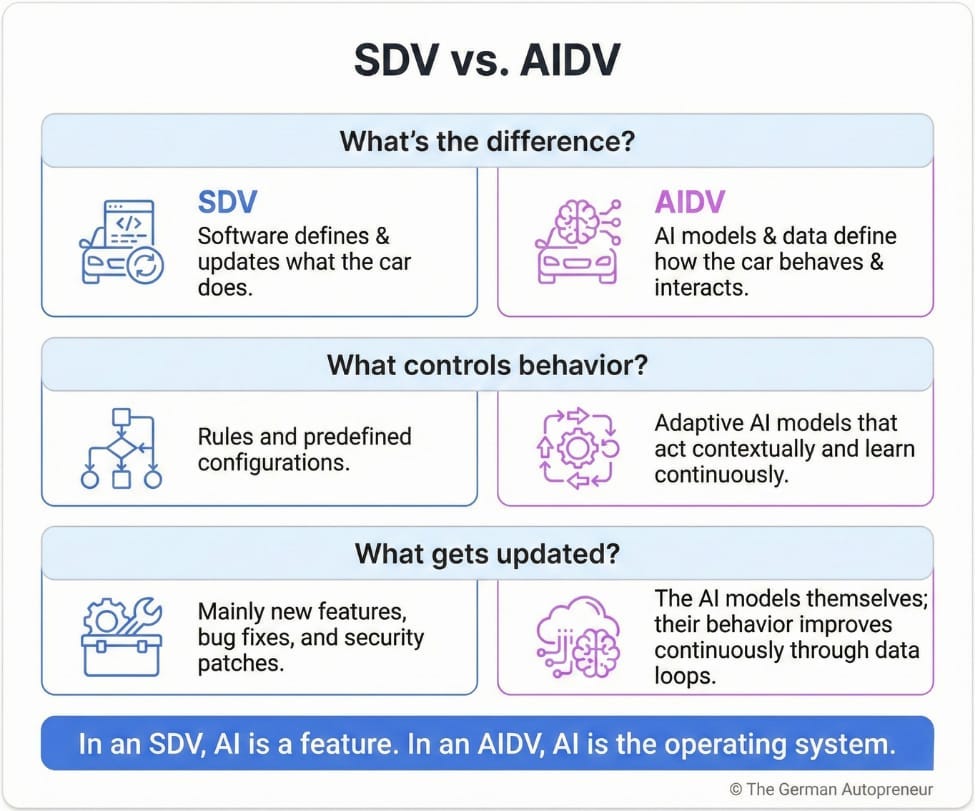
What's the Difference Between SDV and AIDV?
Cars used to be finished when they rolled off the production line. What you buy is what you get. Forever.
With the software-defined vehicle, your car improves after purchase. Tesla unlocks more range via updates. Or new autopilot features. Today you buy a car without lane-keeping assist. Tomorrow you can activate it through a software update.
But you still control the car. You select the driving mode. You decide when to activate lane-keeping.
The AI-defined vehicle flips this relationship.
An AI model continuously analyzes the situation. It factors in weather, traffic, time of day, your destination, even your mood. And it adapts the car accordingly. No input required.
It's the same shift happening on our phones and computers right now. We used to open apps and do things ourselves. Now we just tell an AI what we want. It figures out the rest. Apps become interfaces we no longer need.
The AIDV is the automotive version of this shift. But it goes further. Your car collects more context than you could ever process. It anticipates what you need. And acts on it.
Picture this: You're stressed after a long day. It's late, you just want to get home. The car picks up on it through biometrics. It dims the interior lights, plays calming music, and adjusts its driving style. Smoother acceleration. Gentler cornering.
The next morning you're heading to work. Well-rested, good mood. The car notices that too. It drives more dynamically. Sportier.
In an SDV, AI is a feature. In an AIDV, AI runs everything.
Who's Already at AIDV?
Short answer: China. OEMs like Geely, Li Auto, and Xpeng are going all-in. They're turning AI into the central nervous system of their cars. AI orchestrates not just driving but all vehicle domains: Powertrain, cockpit, climate, energy.
Most Western OEMs are still in the concept phase. They use AI too, but only as one feature among many.
SDV consultant Augustin Friedel came up with a simple test. If you don't meet these 4 points, you're still at the SDV:
Frequent AI model updates. Not just standard software updates
Ongoing tests of AI behavior, with the ability to roll back updates
AI learns independently from driving data, without needing complete retraining
AI is integrated across all systems. Not just a single feature
This matrix shows where each automaker stands. The further top-right, the more AI controls the car. Bottom-left means AI is just a feature.
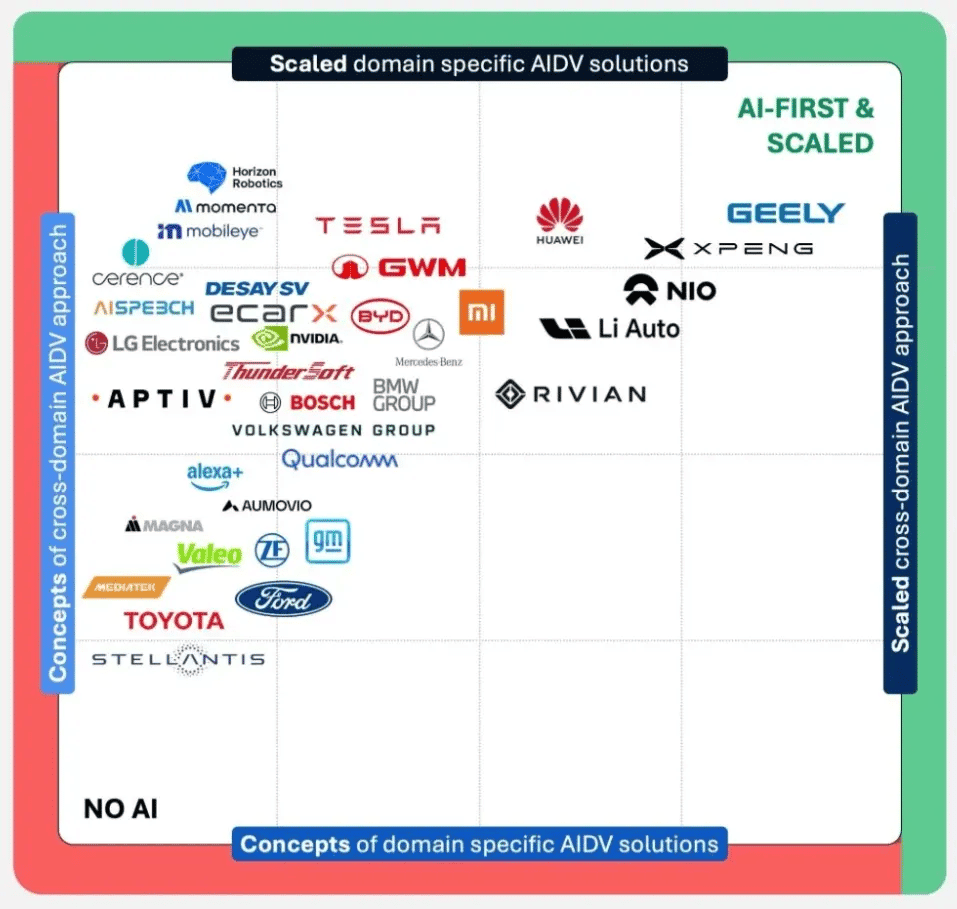
The uncomfortable truth is that legacy OEMs often still struggle with their SDV strategies. Some Chinese players are already one step ahead.
Why Traditional Automakers Struggle So Much
Because it's not just about software updates. It's a completely new architecture.
Chip developer Arm describes 3 simultaneous disruptions:
1) Centralization
All computing power moves to one central high-performance chip. Decades of legacy code have to be ported to a new architecture. For established manufacturers, this is a gigantic transformation. For startups, an advantage.
2) AI-First
AI is no longer a feature. It's the foundation. This requires significantly more computing power, memory, and energy.
3) End-to-End AI
Until now, self-driving systems worked in sequence: one module detects objects, another plans the route, a third handles control. With end-to-end, a single AI model handles everything. It receives sensor data and directly controls steering, brakes, and throttle. No one can fully explain how each decision gets made.
And this third point is the game-changer. End-to-end doesn't just make autonomous driving better. It makes it affordable.
No more 100,000 lines of code for every traffic situation. Instead, one model that learns from data.
Once autonomous driving becomes affordable, robotaxis become reality.
Why Robotaxis Are Coming Now
The cost of autonomous vehicles has dropped dramatically.
Example: LiDAR. That's the laser sensor self-driving cars use to scan their environment. A LiDAR sensor cost $75,000 a few years ago. Today it's under $200.
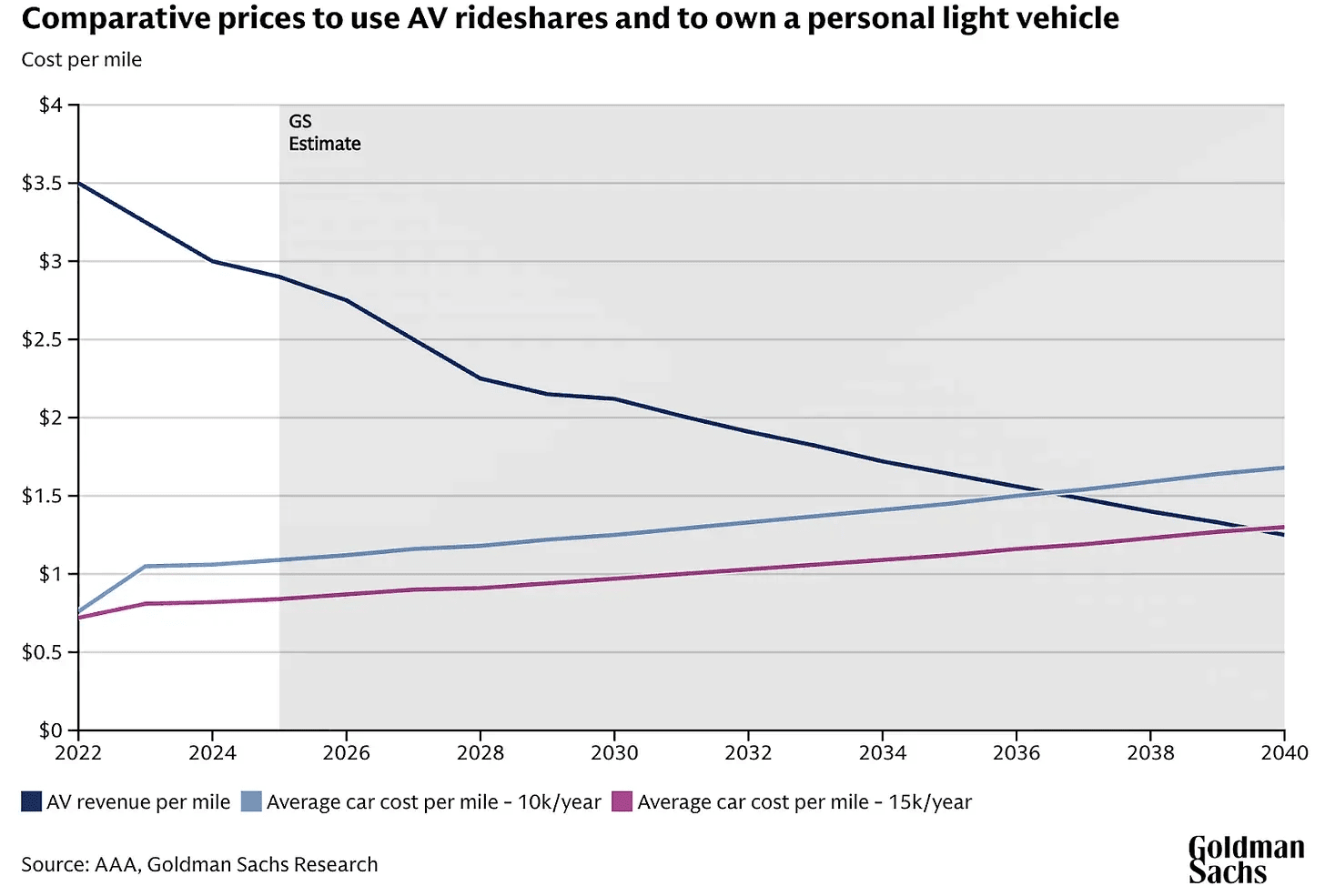
Waymo's new robotaxi costs an estimated $75,000. Baidu's RT6 is at $28,000. Goldman Sachs projected $50,000 per robotaxi for 2030. They've practically hit that target already.
Goldman Sachs expects the crossover between 2036 and 2040. After that, a robotaxi will be cheaper than owning a car.
ARK Invest sees the robotaxi market at over $10 trillion. That explains why 4 of the world's 11 trillion-dollar companies are investing in robotaxis: Alphabet (Waymo), Amazon (Zoox), Tesla, and NVIDIA. Waymo is currently raising $15 billion at a valuation above $100 billion.
For comparison, Volkswagen is valued at around $60 billion. A robotaxi startup is worth almost twice as much as Europe's largest automaker.
And that's why AIDV will prevail. Billions in capital are flowing into development, with or without German automakers.
My Take
The problem isn't that legacy automakers aren't transforming. The problem is they're too slow.
While they transform, the target keeps moving.
German automakers still struggle with software. New models still get delayed because of software issues. Many still can't roll out over-the-air updates at scale.
But they're catching up.
These corporations invest billions. Hire tens of thousands of software developers. Found subsidiaries like CARIAD. And even buy into competitors like Xpeng and Rivian.
All to finally catch up to the software-defined vehicle.
The problem?
SDV is becoming a commodity.
Soon saying "We have an SDV platform" will be like "We make a phone with a touchscreen."
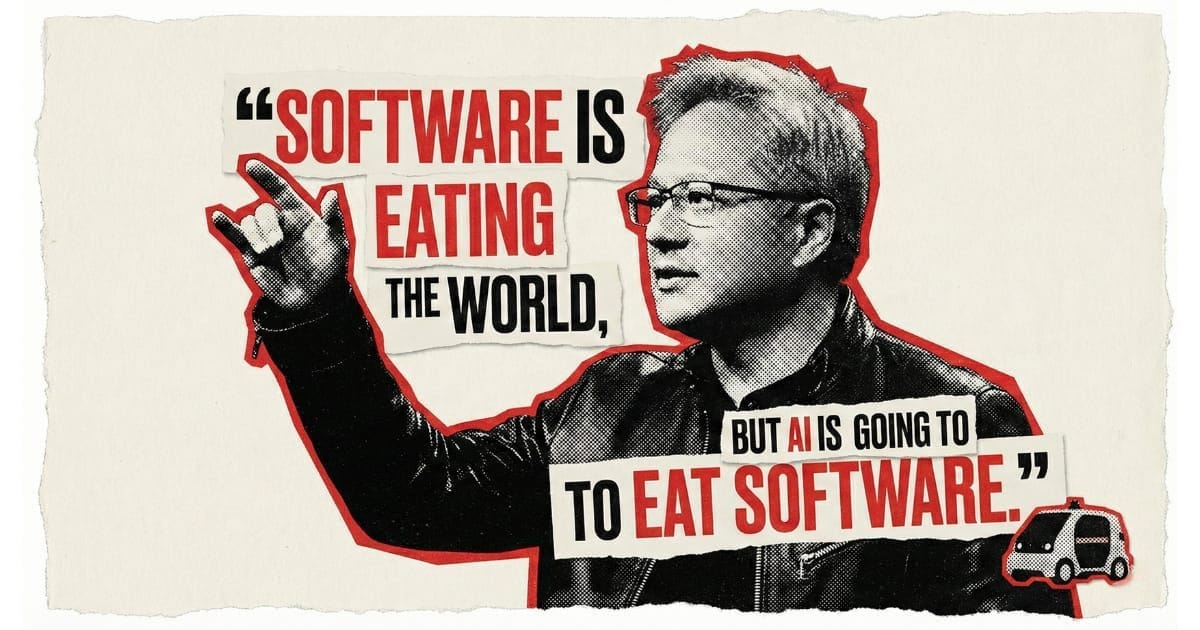
We used to say that software is eating the world. Nvidia CEO Jensen Huang goes further: "AI is going to eat software."
The first automakers are going all-in. They see themselves as AI-first companies.
And that changes everything. With an AI-defined vehicle, an AI model controls all vehicle functions. No more hand-coded algorithms. No modules to maintain. Updates come from training, not coding. At least in theory.
Right now, traditional automakers are hiring tens of thousands of software developers. But an AIDV might not need them. It needs AI models that learn from data.
We might be building skills that become obsolete before we're done building them.
🔗 bi1 | dd1 | ean1 | li1 | sb1 | sb2
That’s all for today.
Until next week,
Philipp
PS: If you find value here, share it with someone who should read it too.
Want to reach European automotive decision makers?
I help global B2B companies connect with 80,000+ automotive decision makers in Germany.