


A word from me
Your product is strong. But German automotive decision-makers don’t know it.
You sell software, tech, or consulting to OEMs and suppliers? Then you know the problem. You can’t reach the right people.
I can help. I get to know your product. Build your positioning and story. And bring it to 80,000 automotive decision-makers.
One partner turned that into 60 qualified leads at OEMs. Another got 250 webinar registrations.
I work with a maximum of 3 companies long-term. Currently 1 spot available.
Welcome to Issue #110 of The German Autopreneur.
German automakers are scrambling to find skilled workers. But: Last year, the industry cut 50,000 jobs.
How do those two things go together?
The automotive industry faces its biggest transformation ever. Powertrains, software, autonomous driving. Everything's changing at once. And now AI is here.
Everyone's talking about it. But most departments haven't changed much yet. Something's coming. But when? And for whom?
A new study analyzed 2 million real AI interactions. Not surveys. Not forecasts. Actual usage data. The result flips a common assumption: AI doesn't automate simple jobs first. It automates the most demanding ones.
Today we'll look at what the data shows. Which jobs and departments in automotive are next. And why most people aren't feeling the real impact yet.

What the Data Shows
The study didn't ask what AI can theoretically do. It measured what people actually use AI for.
The pattern: AI replaces higher-skilled tasks first. Not simple ones.
4 examples:
Travel Agents: Complex trip planning disappears. Ticket sales remain
Technical Writers: Analysis and review disappear. Sketching and on-site observation remain
Teachers: Grading and research disappear. In-person teaching remains
Property Managers: Bookkeeping disappears. Negotiations remain
AI replaces knowledge work first. What stays: Everything requiring personal contact and relationships.
Here's what matters. AI doesn't need to replace the entire job. Every position exists because of 1 or 2 core tasks. When AI handles exactly those, the job is gone.
But how much is actually in use?
For each job category, 2 numbers. How much AI could theoretically handle. And how much is actually deployed today:
Computer & Math: 96% possible. 32% used
Business & Finance: 94% possible. 28% used
Management: 92% possible. 25% used
The pattern is the same everywhere. 60-80% of all office tasks are theoretically automatable. Companies currently use AI for 10-20%.
The gap is massive. But it's closing fast. AI is spreading 10x faster than the internet or smartphones did.
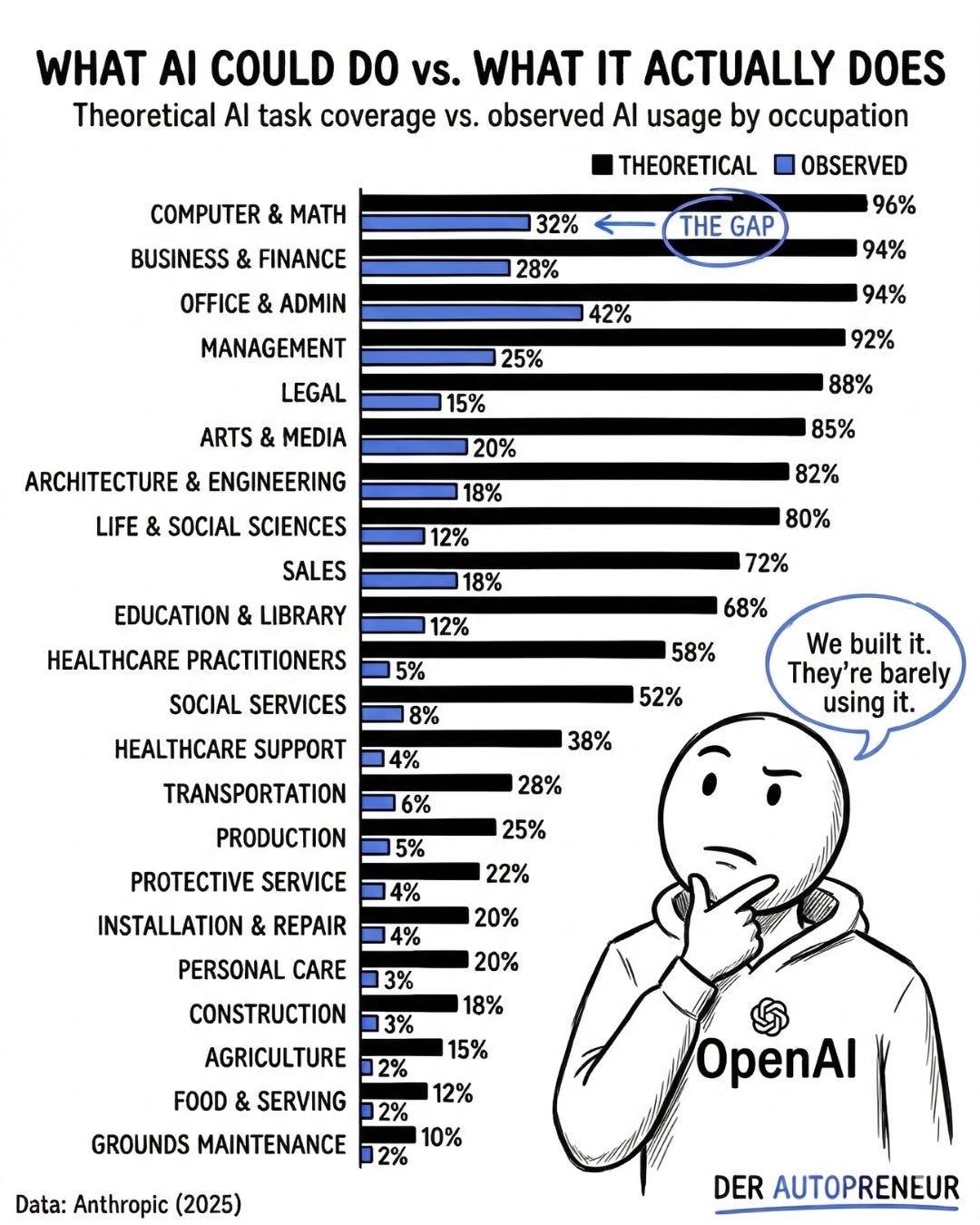
What AI could do vs. what it does (Anthropic)
What This Means for Automotive
Everyone pictures robots replacing factory workers. The data shows the opposite. Production, assembly, logistics, and service shops are barely affected for now.
The disruption is happening in white-collar work.
Where it's already visible: IT and software development use AI intensively.
Where it's coming next:
Simulation and calculation
Finance
Legal and compliance
Strategy planning
AI could handle a lot here. But doesn't yet.
And even where AI doesn't fully replace the job, it transforms it. There's already a term for this. De-skilling. AI handles the demanding part. The analysis. The strategy. The evaluation. What remains: Review results and approve them. The job still exists. But it's different.
For demanding tasks, AI speeds things up by a factor of 12. The more complex the task, the bigger the leverage. And these are exactly the tasks companies pay the most for.
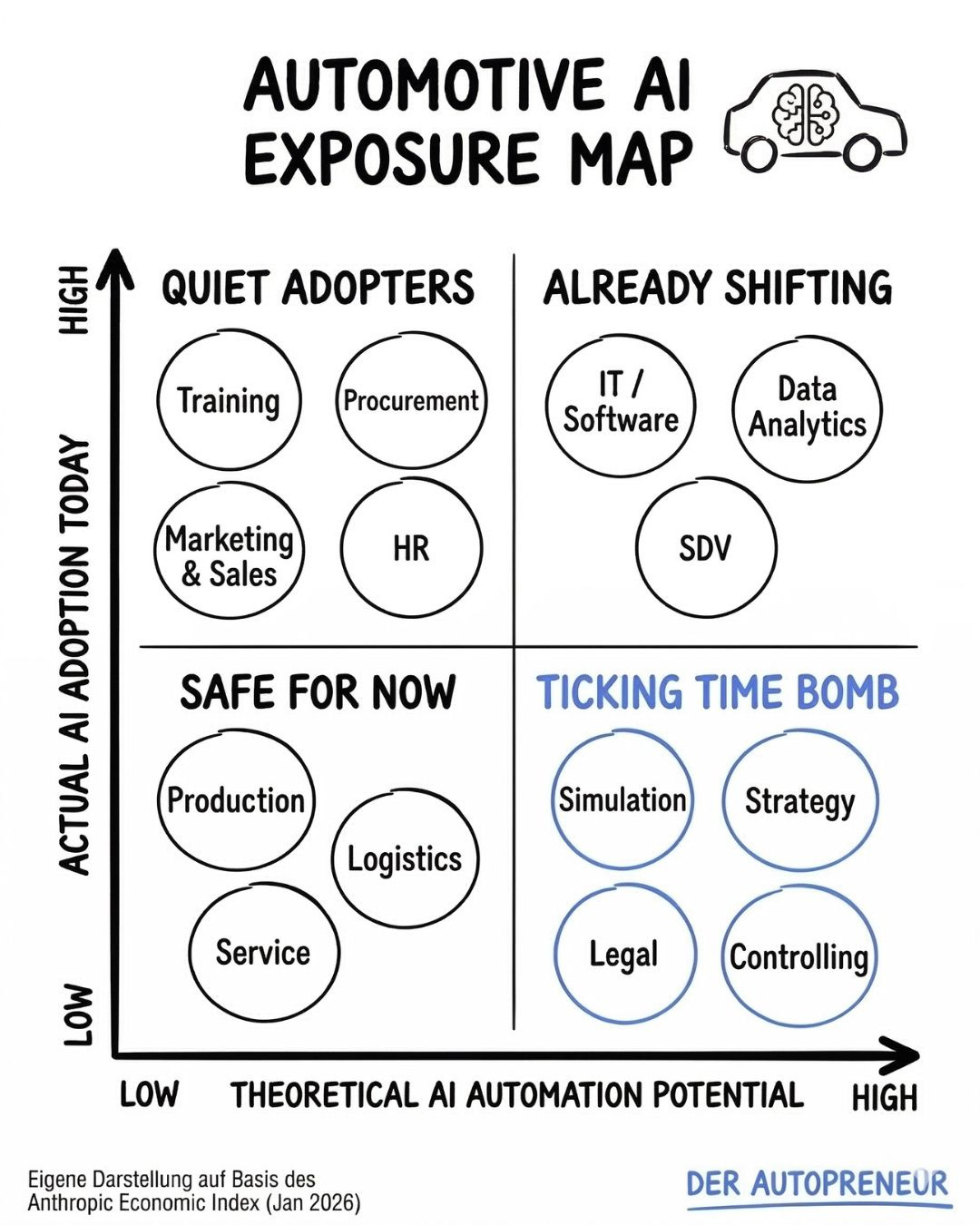
Automotive AI Exposure Map: Which departments are affected?
Who's Still Hiring Juniors?
AI doesn't just change which tasks disappear. It changes who companies hire at all.
With AI, juniors are 26-39% more productive. Seniors only 8-13%. Yet companies hire fewer and fewer juniors.
In European tech companies, junior hiring collapsed by 73% within one year. Not because there are no applicants. But because the positions are vanishing.
The reason: 1 senior with AI can now handle what used to require an entire team. Including the juniors.
So companies aren't just cutting positions. They're replacing old roles with new ones. Especially those who can work with AI.
Which raises a question. If nobody hires entry-level people anymore, where do tomorrow's experts come from?
What We're Not Seeing
So much for the data. But reality is more complicated than headlines.
The headlines say AI destroys jobs. AI replaces people. We're not there yet.
59% of HR leaders admit they highlight AI as a reason for layoffs because it plays better with investors. The real reasons are usually financial: costs, demand, restructuring.
Nearly 90% of surveyed executives say AI had no impact on employment over the past 3 years. Of 1.2 million jobs cut in the US in 2025, only 4.5% were actually AI-related.
There's now a term for it. AI-washing. Companies use AI to explain job cuts that have other causes.
That's the real danger. The narrative is everywhere: AI destroys jobs. But it's not really happening yet. And when the real impact arrives, nobody takes it seriously anymore.
My Take
At Mercedes, we built strategy decks for the board. Entire teams. Weeks of work. For one deck. Today, one person with AI can deliver that in an afternoon. These are exactly the jobs AI is changing now.
And we know this pattern. Digital transformation was the same. Digitize processes, connect data, break down silos. German automakers have known for years this is necessary. And still struggle with it today. Too many entrenched structures. Too many people protecting the status quo. Too little appetite for change.
I'm afraid AI will follow the same path. AI targets exactly where resistance is strongest. It affects the people with the most influence first. And they'll slow it down. Because nobody likes introducing the tool that makes them obsolete.
And that repeats another pattern. Newcomers don't have this problem. Young companies build with AI from day one. Fewer people, faster decisions, no legacy structures. We know this from EVs and software. When you don't need to transform an organization, you move faster.
The problem: AI widens the gap between the fast and the slow. For German automakers, that's an additional risk. On top of everything else already happening.
Jeff Bezos just put $6.2 billion into a fund. It targets industrial companies before AI displaces them. Automotive is explicitly included. His bet: These companies have substance. But won't make the AI transformation alone. So he's coming from outside to force the change.
But the data shows something else too.
The industry seeks skilled workers while cutting jobs. Both are true. Because tasks are changing faster than the people doing them. The good news: The deeper your expertise, the more AI helps. Deep domain experts won't be replaced by AI. They get better. German automakers have plenty of those.
But that only becomes an advantage if these people actually use AI. Not on the side. But at the core of their work. The gap between what's possible and what's used is closing. Faster than any technology before. The question isn't whether AI will change these jobs. But whether we move fast enough.
That's all for today.
Feel free to reply to this email with your thoughts.
Until next week,
Philipp
PS: If you find value here, share it with someone who should read it too.
Want to reach European automotive decision makers?
I help global B2B companies connect with 80,000+ automotive decision makers in Germany.